|
The
shrine of Imam Reza
The shrine of Imam Reza in the center of Mashhad,
Khorasan Razavi province, Iran, is buried by Shiite
Muslims who are honored as a "shrine" by Shia
Muslims. Among its prominent monuments are the
Mosque of Balaser (buried Imam Reza) (1/2 AD) and
the Goharshad Mosque (2/5/2 AD). Imam Reza's shrine
is a complex with the tomb of the eighth Shiite Imam
Ali Al-Musa Reza, which encompasses other mosques,
tombs, porches, scenes, libraries and museums. It is
the largest mosque in the world (6,000 square
meters) and the second largest mosque in the world
(6,000).
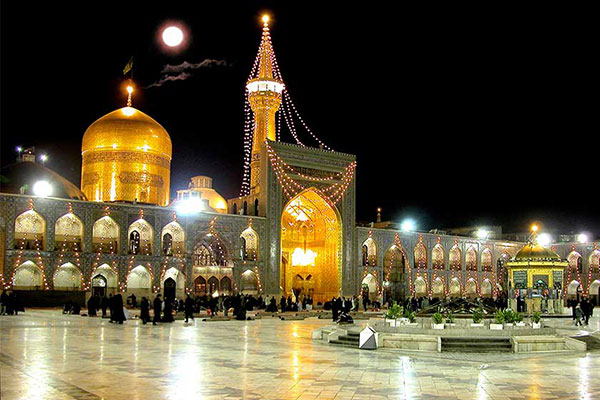
The earliest portions of it date back to the 8th /
8th century. From the Timurid era, many of the
ancient monuments of Khorasan were renovated in Tus,
Herat and Neyshabur. Many of the structures of this
Shiite shrine are left by the Safavids, especially
Shah Tahmasb of the Safavids.
In Persian literature, roumah means the garden, the
flower garden, and the rosary, and the location of
the upper body, including the body of Ali ibn Musa
al-Reza, is called roumah manorah. This area
consists of a square area of 2.5 m 2 of which 2.5
m 2 is the area of the crater. The menorah's
zodiac is connected to the inside and outside of the
shrine through four large planes on four sides.
Mashhad National Garden
Mashhad National Garden is right in the middle of
one of the busiest and busiest residential and
commercial centers in Mashhad. In fact, it is the
first amusement park in Mashhad that was built on
the edge of the old citadel of the citadel. The
national park has now become a local park, but it is
also of particular importance because of its
antiquity. The various parts of the park are
decorated with a variety of old plantations and
different trees, plant species, flowering, grass and
greenery..

This place was actually the citadel of the city, and
Mahmoud Sistani owned it. One of the city's famous
aqueducts, Runkenabad, also passed through the
garden. At present, this large garden with a
fountain and tall trees has become a beautiful and
special place in the hustle and bustle of downtown.
At the heart of this lush garden are statues of
celebrities of science, literature and mysticism.
The garden is currently owned by the municipality.
Reza bazar

Reza Market, located just a short distance from the
holy shrine in Mashhad, has become one of the
busiest and most visited traditional markets in the
country. Besides its beautiful and traditional
architecture, this market is one of the oldest
souvenirs and handicraft centers in Mashhad. The
market is divided into two floors, the second floor
consists of small workshops, gilding, ring making,
turquoise and embroidery.
Mountain Park

Kohsangi Park is the second largest park (after
Mellat Park) in Mashhad. The park is located
southwest of Mashhad and at the end of Kohsangi
Street. Kohsangi Park is located on the edge of high
mountains and is one of the oldest villages in
Mashhad. At the age of 6, King Abbas Safavi was
crowned in the village. Stone Mountain among the
resorts of Mashhad is more famous and is one of the
most beautiful parks made in Iran. The park is a
blend of water, stone and greenery and light.
Khorasan Grand Museum building, exemplified by the
architecture of the rare Kalat palace, has given the
collection a beautiful look. In the 6th year of the
expansion of the city of Mashhad, the mountain was
connected to the main body of Mashhad through a wide
and wide street, called Stone Mountain. With the
development plans of Mashhad, Stone Mountain Park
became a tourist resort.
Astan Quds Razavi Museums
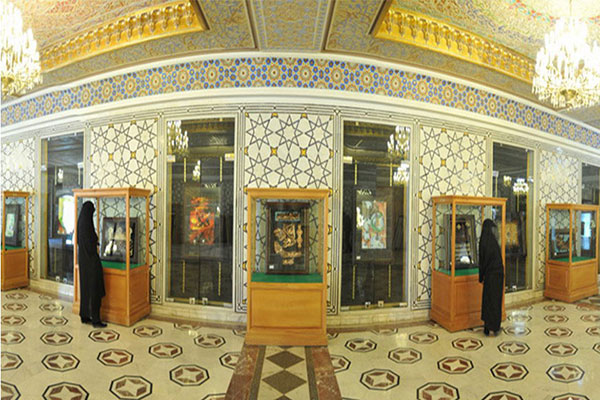
Astan Quds Razavi Museums is one of the largest
collections of museums in Iran whose monuments
represent the six centuries of Islamic period
decorations and architecture and its historical
artifacts represent a variety of arts and crafts
made during the past ten centuries. Astan Quds
Museums are currently housed in four buildings and
exhibited objects include monuments of the holy
shrine and the legacy of Astan Quds, endowed and
donated objects, as well as objects purchased to
complete collections.
Vakilabad Park

Vakilabad Park is one of the oldest and most
beautiful Mashhad resorts located in the southwest
of Mashhad and at the end of Vakilabad Boulevard.
Vakilabad has long been a favorite of city dwellers
and travelers alike for its antiquity and being in a
valley of safe air. The forest park, formerly known
as the Mirtaz or the Vakilabad Garden, was formally
dedicated to public use by the owner, Hussein Mr.
Malek, in Mashhad in the 6th year.
Land Water Wave

Mashhad's waterfront land is built on a
2-square-meter land with a 2-square-foot
infrastructure that is one of the largest water
parks in the Middle East. Topsi Torrey Jumper This
year's winner of the Best Water Jumper of the Year
by the World Water Parks Association. The land of
water waves is the largest indoor water park in the
Middle East and the first of its kind in Iran.
Tomb of Nader Shah Afshar
Tomb of Nadir Shah Afshar A rare museum in the city
of Mashhad designed and built by Houshang Seyhun in
memory of Nadir Shah Afshar in the 6th solar year.
The building of the Nader Shah tomb consists of the
central part of Nader Shah's burial ground and two
museum halls, one of which displays the Arms Museum
of various periods of Iranian history and the other
a Museum of Arms and relics of the Nader Shah era.
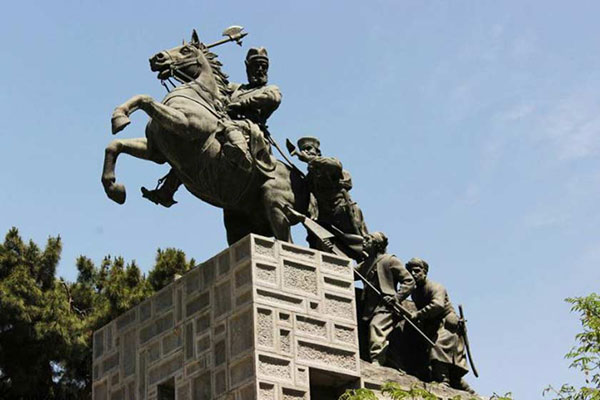
The main space of the tomb is 2 by 2 meters and its
sides are approximately 2 meters wide and 2.5 meters
high. There are 2 monolithic monolithic pillars
around 2.5 meters high around the tomb. The roof of
the tomb is more than 2 meters high. The tomb
features a twelve-step platform, the grave site, a
tent-like canopy, a high platform next to the tomb
with the statue of Nader Shah on horseback, along
with three others looking for it, a bookstore and
two halls as a museum. One is for displaying the
weapons of the Nader Shah during the reign and the
other for displaying weapons of the prehistoric era.
Ferdowsi's Tomb

Ferdowsi's tomb is located 2 kilometers west of the
village of Paj, Toos. Ferdowsi, the Persian epic
poet, was born in the year 6 AH. Ferdowsi's tomb is
considered one of the most beautiful tombs in Iran
that has changed a lot over time, and great
architects have come up with designs to design the
tomb of the great Iranian poet. The mausoleum with
the entrance on the south side is opposite a pool of
2m in diameter that reflects the image of the tomb.
In the inner part of the tomb, the marble gravestone
is one and a half meters long and about half a meter
high, on a marble platform. The second part is a
square hall made of marble and decorated with tiles.
There are four large pillars on the four sides of
the hall that support the spectacular plaster casts.
Each wall is decorated with a similar but shorter
pair of columns in the form of a beautiful loft. The
third part of the building is a staircase of marble
that carved a large number of Ferdowsi's poems. This
valuable work was listed on the Iranian National
Heritage List on April 19.
Tomb of Attar Neyshaburi
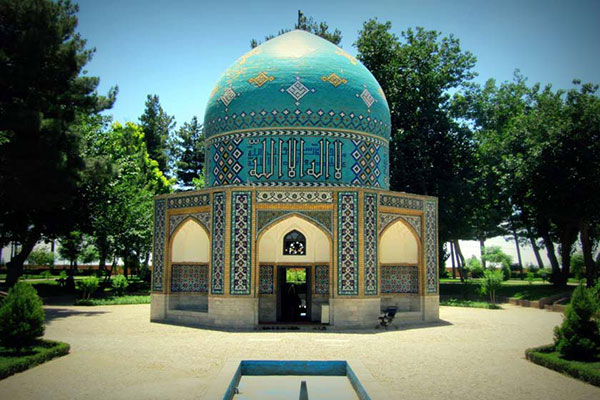
Attar Tomb of Neyshaburi is located in southeast of
Neyshabur about 1.5 km away from Neyshabur road to
Mashhad on the east side and close to Kamal al-Molk
tomb. The current tomb has eight tiled sides and a
dome with four at the entrance. The exterior
features four tiled pavilions, and in the middle of
the monument, Attar's tomb and an eight-meter-high
column of 2 meters high. Attar dome tiles are
adorned with flowers and shrubs, geometric motifs
and Kufic inscriptions in green, yellow, azure and
white. There are four porches on the exterior of the
building. Attar's tombstone is of a black high-rise
type, with poems written on the third line. The
walls are lined with plaster and a few pieces of
poetry emblazoned under the dome.
Omar Khayyam tomb

Omar Khayyam's tomb is located in Neyshabur, in the
garden where the tomb of Imamzadeh Mahrukh is
located. The garden was in the Shiadiakh
neighborhood of Neyshabur at the time of Khayyam's
life and his tomb is now where the military promises
to be each spring. Khayyam Tomb Garden is one of the
most spectacular gardens in contemporary Iran and
has a collection of libraries, museums and
guesthouses. The tomb of this great scientist was
built in the solar year with the design of Engineer
Houshang Seyhoun. A statue of Hakim Omar Khayyam is
installed at the entrance courtyard of the garden.
The area of Khayyam Garden is twenty thousand
square meters and the height of the monumental
lattice is 2 meters and is surrounded by pine trees.
This work is based on a combination of iron,
concrete, and tile decorations in the form of
interlocking rhymes drawn from the mathematical
ideas of Khayyam's life. Khayyam's tomb is one of
the most important monuments of its time in terms of
architecture and construction. This magical monument
is based on the mathematical and trigonometric
principles of Khayyam.
Tomb of Sheikh Ahmad Jami
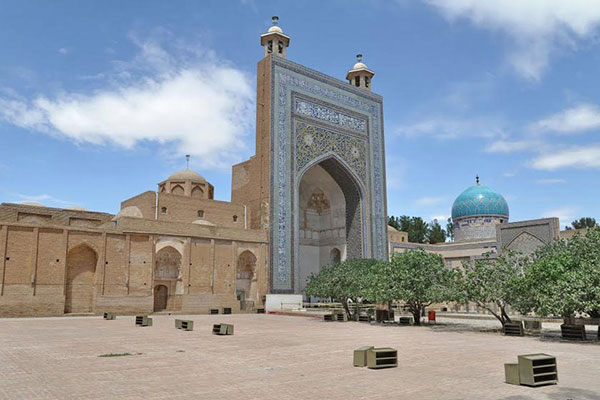
The tomb of Sheikh Ahmad Jami is a tomb and burial
ground of Sheikh Ahmad Jami and has been dating for
nearly 5 years, located in Torbat-e-Jam city in
Khorasan Razavi province. This monument dates back
to the 5th-6th century AD. The building has been
registered as one of Iran's national monuments in
the past year.
Sun Palace

The Sun Palace, also known as the Kalat Palace and
the Sun Mansion, draws amidst a vast area in the
heart of Kalat. It is believed to be one of the few
buildings in the Afshari era, which was supposed to
be a rare tomb of the Shah. The Sun Mansion is a
mysterious and mysterious structure made of brick
and carved with exterior facades of the same rock.
At first glance, the mansion seems to be heavily
influenced by Indian architectural features, as the
materials used on the facade and the carvings of
tropical fruits and birds on them resemble the
appearance of Indian architectural works, but in its
lower layers Has a completely Iranian identity. This
valuable work was registered as one of Iran's
national monuments on January 1, 2009.
It's a monument to Harun

The shrine of Harouniyeh, also known as the tomb of
Imam Muhammad Ghazali, is at the heart of the Toos
Plain. The building is quite brick and has no tile
decorations. The dome has two shells whose outer
covering was destroyed and has been rebuilt in
recent years. On the outer surface of the inner
dome, there are traces of a brick blade that
interconnected the dome structure. The building has
an entrance on the south side with an exceptionally
high loft. There are four spiral stairs in the
corners and three side chambers on the north side.
Inside the dome is simple, and Mithrasites of the
Timurid period are found in the middle porch behind
the north side of the dome. This monument was
registered in the list of National Monuments of Iran
in year 6 under the name of Imam al-Ghazali's tomb.
Radcan Tower (Radcan Mill)

The Radcan Tower (Mill Radcan) is the only tower
capable of determining the four seasons of the leap
year and the beginning of Nowruz. Khawaja Nasiruddin
Tusi's group built the tower at Mashhad during his
ministry at the Halakokhan court. The imprint of the
inscription on the inscription in the tower of the
year 6 AH shows the construction of the buildings
belonging to the Maragheh Observatory at the same
time. Radkan plain and temperate zone is located on
the road to the old Mashhad to Quchan road. This
branch traversed the Silk Road by the river Kashaf
River.
The tower is about 3 meters high and has a
cylindrical body with a cone-shaped dome. The
exterior of the building to the height of three
meters in a rectangular and then to the bottom of
the dome with two or half cylindrical cracks and
inside it is an octagonal that divides the tower
into 2 parts 2 degrees. That is, each wall contains
2 degrees of the angle of the horizon. The most
beautiful part of the Radkan Tower is located in the
upper part of which there are two rows of trains and
two inscriptions of Kufi and Pahlavi, with the name
of the manufacturer and the date of construction
written on the brickwork and decoration.
The body of this tower is very simple and has
ordinary brick and brick and mortar decorations. For
greater strength, the finger bracket joints are
pressed inward, which is noticeable. The interior
design of the Radek Mill Dome is circular and has a
simple, plastered look with plaster and lime. This
monument is listed in the National Monuments List as
of January 2, 2015 with no.
|